Tierra Conquistada
A textual history of the Battle of Covadonga and the origins of the Asturian kingdom in Early Medieval Iberia.

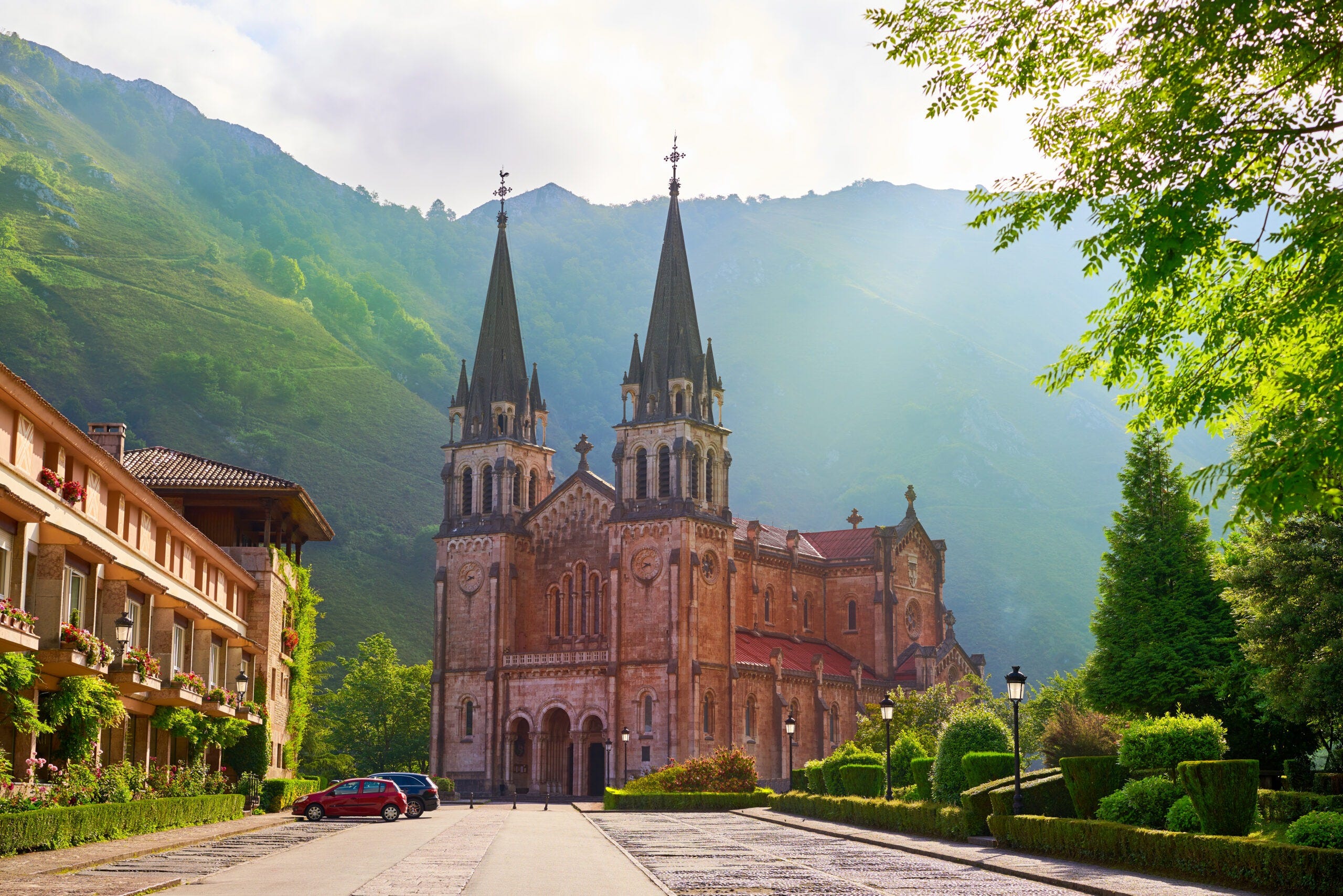
Pictured above: the Basilica of Covadonga
“Asturias es España, lo demás es Tierra Conquistada”
Awakening in a mountain cave, Pelayo—the newly-elected princeps of a small, northern Iberian kingdom—looked out as the sun rose. He had recently fled into the Picos de Europa with his men out of grave necessity. This, of course, occurred after he heard the news—that the Chaldeans (i.e. Muslims) were commanded to arrest him at first sight. However, his flight was not without its own problems. As soon as he got word, Pelayo narrowly escaped from the forces of the Berber governor Munuza in a pseudo-miraculous instance. On horseback, he crossed a mountain stream, and as soon as the Chaldeans arrived, the stream turned into a raging river—bursting from its banks.
Munuza, who had forced Pelayo’s sister into marriage, asked his superior, Tariq ibn Ziyad, to supply him with the necessary troops so he could snuff out Pelayo and his retinue. At the behest of Munuza, general Al-Qama marched from the south into Asturias to apprehend him.
But, scouring the banks of the Enna river, Pelayo observed the Chaldean’s colossal fighting force—which numbered nearly one hundred eighty thousand. His fate seemed to be sealed; the camps of the enemy were innumerable. However, he saw a small entourage of men approaching the cave on foot. Tariq had ordered Oppas, a bishop from the Toledan See, to accompany Al-Qama’s raids in Asturias. The bishop, who had previously collaborated with the Chaldeans during their invasion, began speaking to Pelayo. At his side, Oppas was looking down from the mountain and entreating him to surrender, promising that Pelayo would enjoy the good favor of the new Ishmaelite regime.
Pelayo responded, saying that although his numbers were few, they were like the Mustard seed of Jesus’ parable—they would grow to be great again. After Pelayo also quoted from King David’s Psalms, Oppas retreated, shouting down to the Chaldeans, “Hurry and fight!...you will not obtain peace with him unless by the vengeance of the sword.”
In the ensuing battle, Pelayo’s men—perched on the miraculous mount Aeseuva—crushed their enemy. Through the intercession of the Virgin Mary, projectiles were rendered useless and enemies laid to waste. Most of the one hundred eighty thousand Chaldeans died, but those who retreated were met with an avalanche of major proportions. The wicked Munuza, learning of this crushing defeat, attempted to flee from León—but was captured and killed shortly thereafter.
At the very least, this is the story of the Battle of Covadonga as penned by the author of the Chronicle of Alfonso III. This work, which drew upon some earlier texts and an oral tradition of the battle, was produced and completed in the early 10th century. It was commissioned by King Alfonso III of Asturias, who desired one continuous volume of history to detail the epic story of Asturias. The Chronicle begins with the election of King Wamba—a Visigoth—in 672, and terminates with the death of Ordoño I—Alfonso’s father—in 866.
Some scholars say that the Chronicle of Alfonso III was written to legitimize and “launder” the history of Asturian monarchs, serving only immediate political ends. Whether intended by the authors or not, in the words of Peter Linehan, “...it was from the Chronicle’s narrative that the rest of the story of Spain’s history followed.” The Chronicle is undoubtedly a central text for learning about the construction of a new identity and kingdom, the propagation of new religious practices and understandings, and the story of Covadonga. Its impact on medieval—and even modern—Iberia seems to be very significant.
Since the development of the narrative took nearly two centuries, there almost necessarily were different recensions of the Chronicle of Alfonso III. Though there are four versions of the Chronicle, the two most notable are the Cronica ad Sebastianum and the Cronica Rotensis. Before continuing, it is important to recognize the origins of both of these recensions. The Ad Sebastianum version, argued by Z. García Villada, was the original version of the text for it was more refined in its use of Latin. However, more precise scholarship has shown that this is not the case, and that Ad Sebastianum was written later than the Rotensis. The name of this recension, as noted by Wreglesworth, came from a letter preceding the actual text of the Chronicle, written to an unknown man—a certain Sebastian. The Rotensis version, on the other hand, was given its name because of the earliest codex in which it was found, entitled Códice de Roda or Codex Rotense.
In all versions of the story, however, the authors rendered the Battle of Covadonga to be one of the most epic proportions and the story of Pelayo to be almost hagiographical. The most significant aspects of the text were nearly uniform, but, for the purposes of this paper—and also due to the fact that it was written earlier—I will be mainly drawing on the Rotensis.
Scholars have labored over these two texts at length, and, solely focused on the many differences between the two narratives, they often only provide a skeptical reading. Quite unfortunately, the secondary scholarship regarding the Battle of Covadonga and the life of Pelayo seem to be “hypercritical” in some instances. Most recently, Jose Luis Corral published a large work on the battle and its historiography entitled Covadonga: la Batalla que nunca fue (i.e. Covadonga: the battle which never was). This work, in the vein of hypercriticism, posits exactly what its provocative title implies—that the battle never took place and was a creation of Alfonso III’s court. In addition to this, previous historians seem broadly distrustful of the early medieval Christian narratives. Modern historians seem keen to “throw the baby out with the bathwater,” but the stories of Covadonga and Pelayo verily deserve a second look.
Through a rigorous examination of primary and secondary sources, I will posit that, although the historiography of 10th century Asturias is unavoidably complex, the study of the topic is highly rewarding and relevant. The Chronicle of Alfonso III is a rich look into the distant past—providing readers with early medieval concepts of conquest, kingdom-building and religious practice in a cogent yet elucidating manner. The study of Asturias and its relationship to the Battle of Covadonga showcases a unique picture of Christian life in early medieval Iberia.
The structure of this paper will be as follows; roughly narrowing in scope as we go along. First, I will provide the reader with the context of early medieval Iberia, with a brief description of Visigothic Iberia, the Umayyad conquest in 711, and the establishment of the Asturian kingdom. Then, in a short section regarding the Chronicle traditions of Early Medieval Europe, this paper will briefly illustrate the plural similarities of textual history between the Chronicle of Alfonso III and its contemporaries.
Then, we will turn to the Christian texts of the era more broadly, briefly visiting the Historia Gothorum, Mozarabic Chronicle of 754, and Prophetic Chronicle of 883. After laying this landscape for the reader, I will address the story of Covadonga and Pelayo more directly, through the Chronicle of Albeda and a close reading of the two aforementioned recensions of the Chronicle of Alfonso III. Next, turning to the construction of identities, I will address the foundation of the Asturian kingdom, the development of religious practice, and Asturian conceptions of conquest and battle. Lest we forget the events taking place in the central and southern regions of Iberia, I will address some insights into Muslim historiography and culture in conversation with Asturian expansion. Finally, before concluding, I will address the apparent shortcomings of modern scholarship—and how it has seemingly mistreated Covadonga.
This paper will treat the following questions: How does the Chronicle of Alfonso III compare to its contemporary histories? In what way does the story of Covadonga exist within a broader tradition of chronicle-writing in Early Medieval Europe? What can one glean from the story of the battle? What is the significance of the various Biblical images found in the Chronicle of Alfonso III? What role does religion play in this story? Of what consequence is the silence of contemporary Islamic historiography?
Visigothic Spain and the Umayyad Conquest
Even before the Umayyad Conquest, the peninsula had been settled and conquered by various nations. First, the Iberians in the first millennium BC, then the Celts and Greeks in the eighth century BC. Afterwards, both the Carthaginians and the Romans settled in Iberia after the First Punic War. Prior to the Visigothic conquest in the fifth century AD, in the words of Derek Lomax, “Spain became Latin in language, law and culture.”
With the Visigothic conquest came a great deal of political, social, and hierarchical changes. Although some chieftains integrated into the Hispano-Roman aristocracy, there was still a clear cultural hierarchy; claims to Visigothic lineage were a mode of obtaining greater social credibility and status. Claims to a military or veteran status in a stratified society gave more authority to the newly-triumphant Visigothic peoples.
A great number of Visigoths settled in the Duero River Valley, an agricultural hotspot, towards the north of the peninsula. It is often thought that the Visigoths, after conquering Spain, worked the land as simple farmers, but this is unlikely, for they sought ownership of land, not labor. In the words of Wickham, the Visigothic military culture sought to “rule like Roman emperors.” They thought of themselves as a stand-in for the old Roman authority and acted as such—maintaining some control over old estates. The new Visigothic populace maintained a certain level of commerce between regions, but their economy became more and more localized than their Hispano-Roman antecedents. Visigothic Iberia was far from a well-integrated and cleanly-operating society. In these earlier years, Iberia was quite fragmented. As put by Wickham,
“There were…two processes of fragmentation…One was the loss to central authority of numerous sections of Spain…The other was the development or revival of political practices that were different from those of Rome, more collective, even tribal, in some parts of the peninsula, notably the north. It must be stressed all the same that much of Spain remained very Roman…”
Beyond this, there was widespread political and religious factionalism, especially between those military leaders who had triumphed in the 5th century and earlier extant authority structures.
To understand religious fissures in Visigothic Spain, it is essential to recognize that most of the old Hispano-Roman provincial populace practiced Nicene Christianity, while the Visigothic elite followed a distinct brand of Arianism—another version of Christianity. This was largely true in the earlier years of Visigothic Spain, but, in the late 6th century, Arian Visigoths, lost their influence on the religious discourse of the time. At the Third Council of Toledo, in 589, Reccared—the successor of the last major Arian King Leovigild—publicly converted to Nicene Christianity. This council, presided over by Isidore of Seville, quite importantly stipulated that any later Visigothic king be elected and sanctioned by the Church. Thus, a certain system of election and anointing became essential to the ethos of properly-ordered Visigothic kingship and hierarchy. Although these demands were not always perfectly followed, the Third Council of Toledo provided stability—even if only a certain conceptual stability—to Visigothic kingship and authority. Though it quickly fell apart, the Visigothic rulers of the 6th and 7th century enjoyed greater legitimacy, making Christianity the linchpin of the kingdom. These conversions gave them a somewhat stable—though decentralized—social and religious ethos.
In the 8th century, however, political malfeasance was endemic, and, with the collapse of elective kingship, the Visigothic ruling class was nearly in shambles. Once they began to completely stray from the Third Council of Toledo, the Visigothic elite almost entirely lost their previously-enjoyed legitimacy. This period is described by Lomax as being “an atmosphere of plots, invasions, famines, violence, and terror.” One of the last Visigothic kings, Witiza, was succeeded by Duke Roderick of Andalusia. Roderick—commonly referred to as the “last Visigothic king”—was defeated by Tariq ibn Ziyad, the governor of Tangier, in the Battle of Guadalete. Umayyad control over most of the peninsula became solidified after the Battle of Guadalete. In just a few years, the Umayyads had gained control over a large, unruly landmass and began instituting their own government.
However, the Umayyad conquest diminished once they reached two mountain ranges—the Pyrennees and Picos de Europa. In the ensuing years, they proved to be incapable of crossing into Gaul in any meaningful way. Similarly, Umayyad control over the north—especially when juxtaposed against their state of affairs in the south—was much more tenuous. They had a very difficult time subjugating and conquering the northern Iberians. In the words of Bernard Reilly, “the Muslim occupation of the Duero River basin was never more than very thin and soon became largely confined…in the middle of the eighth century it had become a world of war between Christians of the north and Muslims of the south, which further lessened its attractiveness.” Reilly claimed that the Umayyads had the same lack of control over the Basque country as their Roman predecessors.
Roger Collins likened their ineptitude in such terrains to the Umayyads’ inability to pass through the Taurus mountain range into Byzantium. As suggested by Collins, it is entirely possible that this was due to a lack of tactical awareness, stemming from their familiarity with flatlands. Regardless of whether Collins is correct in this claim, these pseudo-borders are helpful to keep in mind.
History of the Kingdom of Asturias from 722-910
Before continuing further, it is important to understand the broader context of the Asturian kingdom—beginning with Pelagius and terminating with Alfonso III. Without commenting on the textual history of this era, which I will treat later, I will outline some of the basic consensus—regarding lineages, events, and transformations that are meaningful to the study of Asturias. However, this will not be entirely exhaustive, for some kings will be left out of the discussion.
Leaving the origin of Pelayo’s political authority untreated, it is nonetheless a historical fact that he was the initial king of Asturias, beginning his reign as late as 722. In most texts, he is afforded the title of princeps, meaning literally “first,” but having the cultural significance of “being the first man.” It is worth noting that, although they weren’t perfect contemporaries, both Pelayo and Charles Martel—the de facto ruler of the Franks in the late 7th and early 8th centuries—were afforded the title of princeps. This comparison will be important later. In any event, under Pelayo, the center of Asturian power was concentrated in Cangas de Onís, which became a launchpad for later expansion and reconquest. After his death, his son, Fáfila, took control over the newly-founded territory, but he only ruled for two years. Traditionally, he was brutally mauled to death by a wild bear.
Immediately after Fáfila’s short tenure, Alfonso I “the Catholic,” son of the dux of Cantabria, Peter, and husband of Pelayo’s daughter, Ermesinda, became princeps. He ruled from 739 to 757, and, in his eighteen-year tenure, extended his domain into Galicia, Northern Portugal, Cantabria, Alava, and La Rioja. It was during his reign that a monastery and chapel of Covadonga was constructed. The modern shrine, however, was rebuilt later. The reign of Alfonso I was marked with political consolidation, martial conquest, and the construction of a newly-unified kingdom and church in the north. His title of princeps seems to have played a significant role in his political consolidation, for it both gave him greater legitimacy in se and also connected him to Pelayo. It can be assumed that, in part, Alfonso I’s ability to consolidate power came from his two patrimonial claims—to the lineage of Pelayo and the ducal lineage of Cantabria. Here, we see a two-fold relationship, where the legitimate merger of two lineages, through marriage, granted Alfonso I and his successors with more authority.
However, according to Joseph O’Callaghan, territorial expansion under Alfonso I’s tenure was more so due to the lack of Umayyad military presence in their northern territories. At this time, the Umayyads had not consolidated power under a singular emir or caliph—offices which came into effect in 759 and 912 respectively. Only adding to their difficult situation, there was an ongoing Berber revolt, which began in North Africa in 740 and made its way into the peninsula. Because of the Umayyad’s lack of political and social cohesion, the revolt forced their forces in northern territories to retreat further south, in order to quell the rebellion.
After the death of Alfonso I, there was a succession of relatively short-lived kings, and, in 791, his grandson, Alfonso II ascended the throne. Some scholars, like Claudio Sanchez-Albornoz posit that, in this era, kingship was fundamentally elective, but there is some nuance to this point. In the words of O’Callaghan, “the kings who ruled Asturias…in the 8th and 9th centuries were descended from Pelayo and his son-in-law Alfonso I…[with] a pseudo-hereditary principle…[regarding claims] to kingship.” This question is not terribly important, but it nonetheless points to a more general theme of Asturian kingship—that, in this period, deciding who was to be king was a fairly complex affair, one which required claims to a specific patrimony.
Although there was a great deal of territorial expansion under Alfonso I, the real kingdom-building occurred under Alfonso II “the Pilgrim,” his grandson. Alfonso II was markedly the first Asturian king to be anointed at his coronation, and, after his coronation, he moved the Asturian capital from Cangas de Onís to Oviedo. He centered his new capital and courts around a monastery which had existed since the 760s—adding a distinctly religious bend to his reign.
Apart from these expansions, though, he also sent diplomatic missions to the Franks. In the words of John Wreglesworth, “At the close of the 790's, the Asturian king, Alfonso II perhaps concerned about further Muslim assaults on his kingdom, and possibly wary about his powerful Carolingian neighbour, sent ambassadors to Charlemagne and his son Louis.” Alfonso II also had a religious connection to the cult of St. Martin of Tours, an aspect of Frankish culture he admired deeply.
Quite interestingly, it was during his reign that the remains of St. James were found in the town of Compostela—which at that time was part of his domain. He was credited with the construction of a variety of churches in Compostela in order to facilitate pilgrimages and devotional practices. Expanding beyond Iberia, this religious devotion became vastly popular and widespread, and is continued still today.
The historiography of Alfonso II’s time portrayed him as having a dual Hispano-Roman and Visigothic identity, and he was commonly referred to as “Alfonso the Chaste” or “Alfonso the Pilgrim,” because of his support of Compostela. Largely building on the legacy of his grandfather, Alfonso II provided the northern populations of the peninsula with a deep religious fervor, intrepid spirit of conquest, and pious sacral monarch.
The next king worth mentioning, though briefly, is the father of Alfonso III, Ordoño I. In this time, Ordoño used political, fiscal, and martial manipulation to fold smaller Christian kingdoms into his dominion, thus centralizing authority under his crown. His military and political successes seemed, in large part, to be due to the lack of coherence the emirate of Cordoba suffered. In the words of Derek Lomax, “...the emirate was disintegrating under its religious, regionalist, and social strains, and Ordoño took full advantage of this.” It was during his reign—to our knowledge—that historiography treating the Battle of Covadonga initially came about in the Chronicle of Albeda, which we will discuss later. However, the Chronicle that was commissioned by his son, Alfonso III was much more extensive.
Alfonso III “the Great,” much like his predecessors, was intent on proving and demonstrating his patrimony to the Visigothic past so as to create political harmony in the present. He ruled from 866 to 910, and it was in this time that the Chronicle of Alfonso III was produced. He spent the first eighteen years of his tenure fighting against the emir of Cordoba, and the rest of his reign in resettling the Duero valley. New settlements were constructed in Porto, Braga, Viseu, Chaves, and Orense—all the way to the Tagus river. After many defeats, the emirate asked Alfonso III for peace in the north. By the end of his reign, Asturias controlled one-fifth of the peninsula.
Chronicle Traditions in Early Medieval Europe (379-725)
Before continuing further, it is important to have a short explanation of the Chronicle tradition of Early Medieval Europe, as it will further shed light on the Chronicle of Alfonso III. As noted by Burgess and Kulakowski in their work Mosaics of Time, there was a vibrant culture of chronicles in the Christian west, where older chronicles were morphed into contemporary texts—becoming a continuation of earlier stories while gaining greater legitimacy for themselves. These texts, especially St. Jerome’s 4th century continuation of Eusebius’ Chronici canones, were popular in the West, being widely read in Italy, Gaul, Spain and N. Africa.
Across the Pyrenees, in Frankia, the 7th century Chronicle of Fredegar was one of these continuations within the Chronicle tradition—treating the Merovingian and Carolingian dynasties. It was written by the Carolingians, so as to textually render themselves as the heirs of an older tradition. The first two books of the Chronicle of Fredegar sought to legitimize itself by weaving the writings of Jerome, Hippolytus, Eusebius, and even Isidore of Seville into its text.
Though this section is undoubtedly short, it is meant to present a pretext for the subsequent discussion of the Chronicle of Alfonso III and its precedents. The next section, treating Iberian Historiography is certainly, in a similar vein, utilizing past Chronicles—whether with regards to themes or content—to continue their tradition.
Broader Iberian Historiography of the Era (624-883)
Aside from the historiography of Covadonga, which we will treat after this, it is important to understand the landscape of Christian textual history in this era. Although these works were not produced in Asturias, it is worth noting that there was a good deal of thematic overlap between them. Also of note is the fact that, regrettably, there is a near complete lack of documents from the 8th century in the north.
Describing the deficiencies of the north before the 8th century, Reilly writes, “[They] had neither…unity nor a political identity in the time of the Romans or Visigoths. They possessed neither roads, ports, cities, nor bishoprics, of which we are informed.” It seems that the lack of textual culture of the north was due to a deficiency of learnedness and cultural cohesion. Nevertheless, aside from later literature, there are a few important historiographical works worth noting.
Firstly, we will look to St. Isidore of Seville’s Historia de regibus Gothorum—i.e. History of the Gothic Kings. In his Historia, Isidore presents the reader with the tenuous and complicated interactions of Visigothic rulers, from AD 265 to 624. In Isidore’s work, the Visigoths seemingly expanded their domain over the entirety of Iberia, even into Mauritania and N. Africa—with their headquarters at Toledo. This source is also fundamental to understanding the religious tensions and practices of the Visigoths, who initially practiced a unique sort of Arian Christianity. Although my description of the source is brief here, it will become important later, for the Historia carried a particularly significant cultural weight.
In 711, yet another important document, Lament for the Destruction of Spain, was authored. Although it was found in the much later Estoria de España, a work commissioned by Alfonso X in the 13th century, it was dated to the 8th century. This piece of textual history is important to understanding Visigothic and Christian attitudes regarding the Umayyad conquest. As the name suggests, this work mourns for Iberia—which was corrupted from within by Visigothic vice.
The next significant historiographical work was the Mozarabic Chronicle of 754. This document, notably, is completely silent on the story of Covadonga—not mentioning it once. O’Callaghan believes that the silence of the Mozarabic Chronicle is due to the fact that the event was insignificant for the people of Cordoba, where it is thought to have been authored. Its primary aim, more broadly, was to detail the reign of King Rodrigo, saying that he “lost both…kingdom and…fatherland through wicked rivalries.” This theme, namely that of the “sins of the Visigoths,” was continued in the Prophetic Chronicle of 883.
This chronicle, which was likely composed by a member of Alfonso III’s court in Oviedo, continues in the same mournful tone as its antecedents, but with an interesting conclusion. The Prophetic Chronicle expressed a hope that “Divine Clemency [would] expel the Muslims from our provinces beyond the sea and grant possession of their kingdom to the faithful of Christ in perpetuity.” The prophecy itself is one of reconquest, and through the use of the language of Ezekiel 38 and 39, the writer claims that after a 170-year period, Iberia will be reconquered.
When considered in conversation with the earlier section on Early Medieval Chronicle tradition, it becomes immensely clear that such a textual culture existed in Iberia and would inform and influence Christian historiography of Covadonga. It seems entirely plausible that there was a chain of chronicles which connected the Historia de regibus Gothorum, Lament for the Destruction of Spain, Mozarabic Chronicle of 754, and Prophetic Chronicle of 883 to the later semi-hagiographical historiography treating Covadonga and the Asturian kingdom. As we will see shortly, these documents are all necessary for the study of Covadonga’s historiography.
Christian Historiography of Covadonga (881-910)
The first text which outlines the story of the Battle of Covadonga is the Chronicle of Albeda, which was authored in 881. The document gave a continuous history all the way up to AD 976, but scholarship has shown that the sections discussing Covadonga were authored in the late 9th century. It is worth noting that, although the Albeda addresses Covadonga, its main aim was to present continuity between the new Asturian kingdoms and the old Visigothic kingdom. This is where the idea of the chain of chronicles comes in handy for the study of Covadonga.
With regards to the battle, the Albeda spells out a very basic, bare outline of the story. Notably, Pelayo has a unique origin in this version of the story—in the Albeda, he became king after being expelled from Toledo by King Witiza, the aforementioned Visigothic king. This is unlikely, but still an interesting diversion. Regardless, Pelayo ascends to the throne, rebels against the Arab authority, defeats a punitive expedition in battle, and routes the rest of the Umayyad troops. The demises of Al-Qama, Oppas, and Munuza are all described in the Albeda. As a further note, there is complete coherence with the Chronicle of Alfonso III, regarding the length of Pelayo’s reign.
Somewhat worth noting is the absence of the word “Covadonga” itself from the Albeda. This was, in large part, likely because the area and mountain were not originally named “Covadonga.” In both narratives, the mountain where the battle took place was called Aeseuva, and it wasn’t until much later that the mountain was renamed—some time even after the construction of the Marian shrine.
With an eye to thematics, the following passage elucidates the common conceptions of Covadonga. As the Chronicle of Albeda wrote, “Christians are waging war with them [the Muslims] by day and by night and contend with them daily until divine predestination commands that they be driven cruelly thence. Amen.” Also, the Albeda describes the reign of Alfonso II, saying that he “...established in Oviedo, both in the church and in the palace, everything and the entire order of the Goths as it had been in Toledo.” Here, Alfonso II was moving to create a procedurally-consistent authority structure, which would be yet another continuation of the previous Visigothic culture. Since there was an important focus on the procedure by which a Visigothic king would gain power and legitimacy, as we saw with the Third Council of Toledo, Alfonso II’s desire to connect his court with that procedure would certainly have presented his authority as, in some sense, a continuation of previous, extant legitimacy.
The Chronicle of Albeda seemed to be quite intent on linking Asturias to the Visigoths, and, in doing so, constructed Pelayo as a symbol for the whole of Iberia. Beyond this narrative choice, the Chronicle of Albeda was fundamentally a project which attempted to continue the Historia of Isidore—constructing a Visigothic identity for Asturias and a simplified cultural patrimony.
The next text which discusses the Battle of Covadonga is the Chronicle of Alfonso III. As mentioned in the introduction, there were four different recensions, as identified by John Wreglesworth, but the only two of consequence for our study are the Cronica ad Sebastianum and Cronica Rotensis versions.
Scholars often point to the differences between the two popular recensions as evidence for the “creation” of entirely different stories—claiming that, since they diverged in certain parts of their narratives, the two recensions were exclusive of one another and self-contradictory. Although it is undoubtedly true that there is some divergence, the essence of the story is the same in both texts. Each recension emphasizes and characterizes the conflict in Covadonga in a particular—but not exclusive—light. Modern scholarship often presents Covadonga as an entirely mythical or ideological work, which had very little historicity—but this view seems at least problematic and at most to be “hypercritical.” Scholars seemingly avoid discussing alternatives to this reading of the battles' historicity.
Before discussing the differences directly, it is worth noting that these recensions only further indicate that a culture of chronicle-building was at play when the Chronicle of Alfonso III was being constructed. In a somewhat-paradoxical fashion, the differences indicate that, in some sense, there was a discourse and debate regarding the facts of the battle, and thus, there was a tradition of story-telling present in Asturias.
As some background for the Chronicle in general, the narrative begins with the election of Wamba, a notable Visigothic king, in 672, and ends with the death of Ordoño I, Alfonso III’s father. As a matter of fact, the story as found in the Chronicle of Alfonso III wasn’t written down until almost 200 years after the battle. The narrative of the battle, in its essential elements, is presented the same way in the two recensions. In a similar manner as the Chronicle of Albeda, the Chronicle of Alfonso III, in its introduction, identifies itself with Isidore’s Historia de regibus Gothorum—by also taking certain elements of Isidore’s writing and repackaging it with the newer brand of Asturian historiography. This would likely have given the Chronicle more textual clout in those days.
There are a few key elements of Covadonga’s narrative that are common to all recensions of the Chronicle. For one, in all versions of the text, Pelayo ascends to kingship through widespread common acclaim. He did not inherit the crown in a hereditary manner, but became a leading man in Asturias on his own merits. Munuza, the governor or administrator of that region, sought aid from the Cordobans and ordered general Al-Qama to go on a punitive search for Pelayo. Then, Pelayo fled from the Muslim forces, finding safe refuge in the caves of Mount Aeseuva—which was later renamed Covadonga. Over a certain period of time, Pelayo began to grow his force—which was made up of many Visigoths who had fled the Muslim invasion. And, one day, Al-Qama and his forces arrive, riding with the nefarious Bishop Oppas. A dialogue between Oppas and Pelayo occurs, the battle ensues, and, miraculously, Pelayo and the Asturians prevail. Afterwards, Munuza is hunted down and killed.
It seems that the differences between the Ad Sebastianum and Rotensis versions are many, but are somewhat inconsequential to the story-telling taking place, for they are quite small. Some scholars seemingly focus too critically on this matter, but that will be treated later. The three most discussed differences in the two recensions are: 1. the lineage assigned to Pelayo, 2. the reason for Pelayo’s departure, and 3. the bishopric assigned to Oppas.
The first disagreement is that in the Rotensis, Pelayo is described as a spatarius—a simple soldier—and in the Sebastianum, he is depicted as a man of royal stock—a pure and clear remnant of the Visigothic nobility. In both texts, however, Pelayo ascends to his new role through an election. The extant Visigothic aristocracy, who were said to have fled into Asturias, were the ones who elected him king. For, in the Rotensis it is said, “...from this cave, where a great river called the Enna springs forth, he sent messages throughout Asturias, gathering the people who then elected him as their leader.” And, in the Ad Sebastianum recension, “...the greatest part [of Visigoths] entered into the country of the Asturians and chose for themselves as leader Pelagius, the son of the former duke Favila from the royal seed.” This only serves to demonstrate the ideal of a continuation between Visigothic and Asturian authority.
So, although there is a disagreement in the texts, it seems that the important questions are not of the difference in his hereditary status, but rather the manner in which he was elected—by the people. As discussed earlier, there is a plurality of historical opinion on whether kingship—in this time—was hereditary or elective, and the constancy presented in these two passages seems to imply that the latter is more true of early Asturian kingship.
The next disagreement is in the reason for Pelayo’s retreat into the Picos de Europa mountains. In the Ad Sebastianum, Al-Qama is sent to Asturias because of Pelayo’s election, but, in the Rotensis, Pelayo retreats following a conflict with Munuza—who had married his sister while he was away. It doesn’t seem particularly consequential to the narrative whether or not Pelayo’s sister was taken or whether the Umayyads were simply aggressive against any show of kingship—for the following reason. In the Rotensis, although Pelayo is spurred on by Munuza’s deceitful taking of his sister, he nevertheless moves “with great determination to act for the salvation of the Church.” Thus, although there is a divergence in the details of the story, the simple fact remains: that Pelayo retreated into the mountains because he was pursuing political sovereignty in the north.
The third, and possibly least interesting “major” disagreement which is present in the two recensions is over which bishopric Oppas was assigned. Oppas, who takes a fairly central role in the narrative in all recensions of the Chronicle of Alfonso III, was described as being the bishop of Seville in Ad Sebastianum and the bishop of Toledo in the Rotensis. Again, the difference between these two sources does not imply that the sources are entirely contradictory, but rather demonstrates something else entirely. For the authors could have either been mistaken or used the denotation of Bp. Oppas’ See as a political ploy, as some suggest was the case with assigning him the Toledan See. Also worth noting is the fact that Seville was the place from which Isidore came, and Toledo the place in which his efforts—i.e. converting the Arians to Nicene Christianity—came to fruition. Seville is the mastermind, and Toledo the central authority whom corrected the religious culture of Iberia. Regardless of these two options, many historians understand him as being the bishop of Seville, for, as Collins notes, “a tenth-century set of episcopal lists [seem] to indicate the existence of a bishop Oppas of Seville at some point in the early 8th century.”
More important to the text, however, is not from whence Bp. Oppas came but from whom he came. For, in both recensions, Bp. Oppas is described as being a relative of King Witiza, the aforementioned Visigothic king. Thus, in the eyes of Linehan, “Bp. Oppas represents the Visigothic establishment.” This identification is in line with the broader historiographical culture of the 8th and 9th centuries, which regarded the Visigoths as the cause for the Umayyad conquest.
Equally important was Oppas’ identification as a cleric, for, as we will see upon further reading of the document, his identification with the church could have entailed some very interesting ramifications for believers. His treacherous nature, in that he aided the Umayyad conquest, is mentioned in both sources—implying that, at least in some sense, the old Visigothic hierarchy of power was inefficient and corrupted. This is largely in line with the narrative mode of previous chronicles, which implied that Visigothic moral corruption was the cause for the loss of Iberia.
Apart from the replies offered above, treating the differences in the Rotensis and Ad Sebastianum recensions, there are two other very important considerations when studying the Chronicle of Alfonso III. Firstly, it is essential that any reader understand that these two works, though they both draw on the same source material and oral tradition, were seemingly produced nearly ten years apart. The Rotensis was likely written by a less sophisticated Latinist some time before 910, and the Ad Sebastianum was written by a different author in 915. In fact, since the Ad Sebastianum has such an intricate use of the Latin language, Collins suggests that it was written by a cleric, Collins goes even further, saying that the Ad Sebastianum recension, because of its unique sophistication, could have been produced at a much later date, even in the 11th century. As further proof, Collins presents the Rotensis version as the blueprint for the Ad Sebastianum. Under this pretext, it seems that the more salient and realistic source of historical knowledge would flow solely through the Rotensis.
The second consideration is the source material which the Chronicle of Alfonso III had access to. Aside from the Chronicle of Albeda, and hypothetical some unknown “lost texts,” the story of Covadonga must have—as a matter of necessity—been passed down orally. It is entirely possible that, although the “broad strokes” of the battle’s events were consistent across different tellings over the 180-year span from the battle to the Chronicle, certain small details were distorted, lost, or changed. Further vindicating the theory that the story was passed down consistently through an oral tradition is the fact of the story’s prominence in Northern Iberian history. In the same way that Americans tell their children stories of the Founding Fathers, the story of Pelayo—which is intrinsically tied to Asturian history—could have been passed down.
Construction of Identities
One of, if not the most interesting aspects of the Chronicle of Alfonso III, is the construction and continuation of identities. Through studying the text, a reader will nearly immediately notice its inherent Catholic, monarchic, and Visigothic themes. Although there is a lot of critical scholarship treating the historicity and trustworthiness of the Chronicle, very few go into a thoughtful, in-depth analysis of these themes and how they could have shaped Asturian culture.
Interestingly enough, to claim that the Ad Sebastianum—and not Rotensis—recension was written by a cleric seems to be somewhat problematic. For, when examining the Rotensis, it becomes immensely clear that the entire story drew on and built upon Biblical themes. Thus, it seems that both recensions were written by clerics, for to have such a rich, religious narrative would surely have taken a learned cleric. These religious allegories, though untreated by many scholars, were somewhat drawn out by Linehan, who noticed the pattern.
From the outset, the Rotensis version is rife with Biblical references and allegory. The symbol of women being taken by an evil authority figure, as Pelayo’s sister was taken by Munuza, appears in various places in the Bible. For example, the story of Dinah and Shechem in Genesis 34, the story of Sarah and Pharaoh and Abimelech in Genesis 12 & 20, as well as the story of Tamar and Amnon in 2 Samuel 13 all present this sort of event taking place.
In the original Latin, the Umayyads are referred to as Ishmaelites, identifying them with their Abrahamic roots—not merely as Arabs or Saracens, but as descendants of Ishmael. Pelayo’s origin story, as dictated in the Rotensis, was that he was a simpler man—a spatarius, which roughly translates to “bodyguard.” His path to kingship then, has an implicitly Davidic theme; for he went from being a bodyguard to king just as David had gone from being a shepherd to a king.
Along this line of thinking, as well, is the obvious characterization of the Umayyads as a Goliath-esque force and Pelayo as David. Ahead of the battle, Oppas told Pelayo to retreat or quit—with the implication that, since the Umayyad fighting force was superior in number and quality, the Asturians were doomed to perish. Aside from these two links, there are many additional stories of David which are parallel to those of Pelayo. In 1 Samuel 22, David flees King Saul and finds refuge in the cave of Adullam, where he gathers a retinue. Later, David, as described by 2 Samuel, reunified the kingdoms of Israel and Judah under one monarch. This, in some sense, parallels the Asturian desire to reunify the Visigothic and Hispano-Roman peoples, so as to reconquer their territory from the Umayyads. Even further, when responding to Bishop Oppas, Pelayo quotes David’s verse in Psalms. Though the parallelism between David and Pelayo may be a cliche, it seems to nonetheless be apt.
Linehan posited that the dialogue between Oppas and Pelayo mirrored similar dialogues in the Latin Vulgate, but the allegory would simply not fit. The two examples he cites are God asking Adam “ubi es?” in Genesis 3 and Moses responding to God with “adsum” in Exodus. However, since these are relatively simple latin phrases, and the parallel of Oppas-as-God does not fit into the narrative—since he is the adversary—it seems that this allegory was unintended. It would be contradictory for the nefarious bishop to be symbolized as God. Far more interesting a Biblical allegory would be reading Oppas as Satan himself.
The Pelayo-Oppas dialogue, in a certain sense, mirrors the dialogue Christ has with the Devil in Matthew 4. But first, before treating this, a look to the text:
"Pelagius was atop…Aeseuva…The aforementioned Bishop Oppas climbed a hill before the Lord’s cave and addressed Pelagius, saying: 'Pelagius, Pelagius, where are you?' Pelagius answered from the window: 'Here I am.' To which the bishop said, 'I think you [know]…of how all of Spain was once united under the rule of the Goths, ordered in a single governance, and how it shone above other lands in learning and wisdom. Yet when, as I have mentioned before, the entire army of the Goths was gathered, they could not withstand the onslaught of the Ishmaelites…Listen instead to my advice: abandon this intention of yours, so that you may enjoy many good things and share in [their] fellowship…' To this, Pelagius replied, 'Have you not read in the Holy Scriptures that the Church of the Lord is compared to a mustard seed, which from the smallest of seeds grows again, by the mercy of the Lord, into something greater?' The bishop answered, 'Indeed, it is truly written so.' Pelagius continued, 'Our hope is in Christ. It is from this little mountain you see that the salvation of Spain and the restoration of the Gothic nation’s army will arise. I trust that the Lord’s promise will be fulfilled in us, as was spoken by David: I will visit their iniquities with a rod and their sins with scourges, but I will not take my mercy away from them. Now, trusting in the mercy of Jesus Christ, I despise this multitude and fear it not. As for the battle you threaten us with, we have an advocate with the Father, the Lord Jesus Christ, who is able to deliver us, even though we are but few.'”
Although it is clearly not a perfect parallel, the above dialogue is certainly influenced by Matthew, for, as it was written:
Then the devil took him up to a very high mountain, and showed him all the kingdoms of the world in their magnificence, and he said to him, “All these I shall give to you, if you will prostrate yourself and worship me.” At this, Jesus said to him, “Get away, Satan! It is written: ‘The Lord, your God, shall you worship and him alone shall you serve.’” Then the devil left him and, behold, angels came and ministered to him.
Without too much explanation, a reader can clearly see that the Pelayo-Oppas dialogue mirrors in some way that of Christ's interaction with Satan in Matthew. Oppas is presented as a treacherous man, who tempts Pelayo with temporal gain—only to be rebuffed by the quotation of scripture. Christ, in Matthew, rejects Satan in the same way—through a scriptural reference.
However, a Biblical or Davidic reading of the Chronicle of Alfonso III is not too far off—the text itself, after finishing the story of the miraculous victory in Covadonga says “Do not think this to be a vain tale or a fable. Rather, remember that He who opened the waters of the Red Sea for the passage of the children of Israel is the same one who crushed these Arabs with the massive weight of the mountain as they pursued the Church of the Lord." Thus, the story of Covadonga holds a special significance—not only a spiritual one, but a Biblical one. It became, through the semi-hagiographical Chronicle, a continuation of the Christian tradition in a significant way. Beyond this, the “Biblical legitimization” of the story of Covadonga would also seemingly serve to identity the Asturians as a new chosen people—one guarded and protected by God’s will. Understanding the biblical allegories of the Rotensis gives a modern reader better insight into the culture in which this story was written and received.
Also of significance is the site itself, which, as early as the reign of Alfonso I, had a popular shrine built to venerate Our Lady of Covadonga. It was through royal mandate that this chapel became a reality, and, much like the later devotion to Santiago de Compostela which arose under Alfonso II, the monastery and chapel of Covadonga was informed with a certain royal ethos. According to tradition, the shrine was built by Pelayo’s grandson in the very cave from which he triumphed—it was an essential part of the Asturian founding myth. Thus, the holy site seemingly became a mode of not only securing religious devotion, but also informing the people of their political patrimony.
Covadonga in Arabic Texts
When it comes to the Arabic understanding of Covadonga, modern scholarship is seemingly insufficient for providing us with a coherent picture. Scholars are overly focused on two problems; 1. There were no contemporary Muslim sources writing about Covadonga, and 2. The first source we have which treats Covadonga from the Muslim perspective was written in the 17th century by Ahmed Al-Maqqari.
Some historians treat the silence of Muslim historiographers as dispositive —saying that, since the Muslims didn’t write about Covadonga, it was much less significant than we think. They also point to the silence of Christian writers, like the author of the Mozarabic Chronicle of 754, saying that, since those authors didn’t speak of Covadonga, it would be untenable to consider it to be nearly historical. Others, like Jose Luis Corral, point out the absurdity of the premise, by noting that:
“the two most striking aspects of the Arab chronicles [about] al-Andalus are how late they were written—since the earliest…were not composed until a century after the conquest, later than the first Christian chronicles—and the absence of contemporary accounts ...The oldest ones were not even written in al-Andalus, but rather in Arabia and Egypt, and therefore offer a…secondary perspective on what happened in Hispania, with very different viewpoints among them…”
There exist a number of reasons for Muslim silence on the battle, but the plain fact of their lack of historiography at this time seems to put the question to rest.
Now to the question of “what to make of Al-Maqqari’s account?” In his 17th-century compilation, Al-Maqqari quoted earlier historians for the escape of the hostage Pelayo from Cordoba during the governorship of Al-Hurr (AD 716-718), the sixth year after the conquest. He names two historians, Isa ibn Ahmed al-Razi and Ibn Hayyan, who place Pelayo's rebellion under the later governor, Anbasa.
Al-Maqqari describes the Asturians as being reduced to only thirty men and ten women, forced to scavenge for food among the rocks—thus minimizing any claims to an epic or mythical victory at Covadonga. However, this simply seems to be a rhetorical move. Al-Maqqari’s account seems unlikely, for it writes Pelayo’s rebellion off as being something entirely unimportant—it seems to be a political or ideological move.
Yet, why would the story have been propagated at all? If the Asturian revolt under Pelayo was truly and verily only just forty rebels who were hiding from the Umayyads, then why on earth would the story have survived for nearly nine hundred years? It seems that, because of Al-Maqqari’s—or the previous historians’—deep focus on disproving the Asturian understanding of Covadonga, he seemed to make a wild claim—that the battle never happened. This seems entirely unlikely, for, as we know, it only took a few years for a shrine to be built at the site—under the reign of Alfonso I. So, it seems that Al-Maqqari’s treatment of Covadonga is insufficient in explaining what happened, but it can give readers insight into how Muslims thought of the battle—namely, that they sought to minimize it, even into the 17th century.
Modern Scholarship
As described earlier in this work, modern scholars seem to think that Covadonga was either a fabrication or entirely ahistorical. Many scholars posit that the reason for the writing of the Chronicle of Alfonso III was the consolidation of political power, but fail to look beyond medieval power dynamics. José Luis Corral’s book Covadonga: la Batalla que nunca fue (i.e. Covadonga: the battle which never was) is the epitome of “hypercriticism” in historiography treating Covadonga. As he presents it, Covadonga was simply a creation of Alfonso III, and defenders of the traditional historiography, like Sanchez-Albornoz, are simply ideologues—serving political ends.
Corral’s work provides its readers with a fair amount of interesting questions, but nonetheless, his entire book is suffused with an anti-traditionalist ideology of its own. In his quest to disprove those closer to Sanchez-Albornoz’ thinking, he becomes hypercritical. In one notable instance, he writes saying that there is essentially no archaeological evidence for the existence of the battle, but this seems disingenuous—for the answer is staring right at him. The answer to the presupposed “lack of archaeological evidence” is found in the chapel and monastery of Covadonga itself. Though the aim of my work is not to discredit Corral’s book, it seems that his research was quite biased.
Failures of Modern Scholarship
Modern historiography can often by frustrating for its rather simple-minded perspective. Most historians seemed to present the various chronicles as ideological fairy tales for somewhat flippant reasons. For example, as discussed above in the section regarding the divergence in the Rotensis and Ad Sebastianum recensions, the differences were not entirely essential to the narrative—and it should not be concluded that they warrant a wholesale rejection of Covadonga’s historicity. A lack of one, detailed, and coherent voice is challenging, but modern scholarship is too quick to cast Covadonga aside. Unfortunately, scholarship on Covadonga seems to have been rife with ideology from the outset—from both the traditional narrative’s proponents and critics. For both groups, Covadonga became a story of political power only, with very little work being done on the textual or religious elements of the battle.
Another failure of some modern scholarship on Covadonga is a tendency to treat the Umayyads as a strong, authoritative monolith. Although it is true that they exerted control over vast swaths of the peninsula in a very short amount of time, long-term hopes for a Muslim-ruled Iberia were tenuous from the outset. In the words of Michael Cook, “The resources of Muslim Spain were not, however, enough to support a reliably strong state, still less an imperial one…The Arabs had successfully co-opted the Berbers for the conquest of Spain, but they failed to co-opt the Basques…Meanwhile, a sizeable part of northwestern Spain was to escape their rule.” Even in their capital, Cordoba, there were massive tensions which prevented coherent political rule in the 9th and 10th centuries.
Even more tenuous were their intercultural relations—with a sharp divide between Arab and non-Arabs being almost essential to this period of Muslim history. Adding to these intercultural tensions were sharp religious divides, with Maghrebi Kharijites and Shiites being in conflict with the majority-Sunni Umayyads. Christian Sahner writes, on the topic of ethnic divide in Umayyad culture, saying:
“...many early Muslims saw their religion as a special monotheism for the Arab people, and therefore, as we have seen, converts had to both embrace the Muslim faith and become clients of an Arab tribe. Naturally…leaders looked warily upon non-Arabs who embraced the new religion. Such elites, who maintained a monopoly on power…despised the mawālī as second-class citizens and strove to distinguish themselves from non-Arabs through legal and financial means.”
Although the Umayyads had a great deal of power in Iberia, it is often overblown by historians—especially when writing of the 8th century. At the time of Covadonga, there was no emirate nor caliphate established in Cordoba, with the main de facto rulers of the time being generals or other military figures. An example of such a shortcoming is in the work of Joseph O’Callaghan, who wrote that “...for most of the 9th, 10th, and 11th centuries, the Christians were at the mercy of the Muslims and could only make weak and ineffectual efforts to oppose their intrusions.” Another example is found in Early Medieval Spain by Collins, who wrote that “The Umayyad government in Cordoba was extremely centralized…[but] their influence did not extend as far north as it could have.” When put into conversation with Cook and Sahner’s work however, both O’Callaghan and Collins seem wrong on these points, for they fail to nuance their claims about Muslim government and power with the recognition of the Berber Revolt of 740 and the Cordoban Rebellion in 818. As Cook noted, Umayyad hegemony began to dissolve in these times, with some generals like Ibn Hafsun threatening to lay siege to Cordoba itself in the 10th century. It seems that, although the Umayyads held a grasp over Iberia—it began to slip out of their control from the outset.
Explicit
Through a rigorous study of medieval Asturian texts, it seems that the Chronicle of Alfonso III served both historical, political, and religious ends. It built upon precedent, highlighted distinct aspects of the battle, and was quite influential. Since it likely came about through an oral tradition, the details of the battle are consequently somewhat unclear at times, but the overarching themes and more fundamental facts remain consistent. The key to the study of Covadonga —through these texts—is to absolutely not get lost in the weeds, with details of provenance, kinship, or place-names. It prided itself on being a continuation of Isidore’s Historia de regibus Gothorum, but seemingly diverged. It presented a more explicit view of what Iberia was, who its rightful rulers were, and what faith she should follow. Elements of the Prophetic Chronicle, Mozarabic Chronicle, and Chronicle of Albeda are absolutely present in the Chronicle of Alfonso III.
As mentioned earlier, one pitfall of modern scholarship regarding Covadonga and its historiography is that it treats the story of the battle like a simple political tool—with religious elements—which was produced in order to garner more legitimacy for the Asturian monarchs. Through a closer reading, however, it becomes clear that this text is as much a political one as a religious one. The story of Covadonga, as presented in the Chronicle of Alfonso III provides readers with an optimistic and providential vision of the kingdom of Asturias—and its future. And, although in this time those two spheres were not entirely distinct, modern critics fail to make mention of the richer, traditional elements of the text. It was a continuation of previous chronicles, not a stand-alone fairy tale solely produced for mere political ends as Corral thinks. Religion is essential to the story of Covadonga, and any reading of the texts without deep reflection on its continuation and creation of Christian tradition is entirely inadequate to the study of history. Without understanding the religious element of the story, one risks taking it either at face value or no value at all. I believe that, in order to understand this period best, one must strike the middle road; not taking the narrative as objective, but also not casting it aside as a simple piece of political rhetoric.